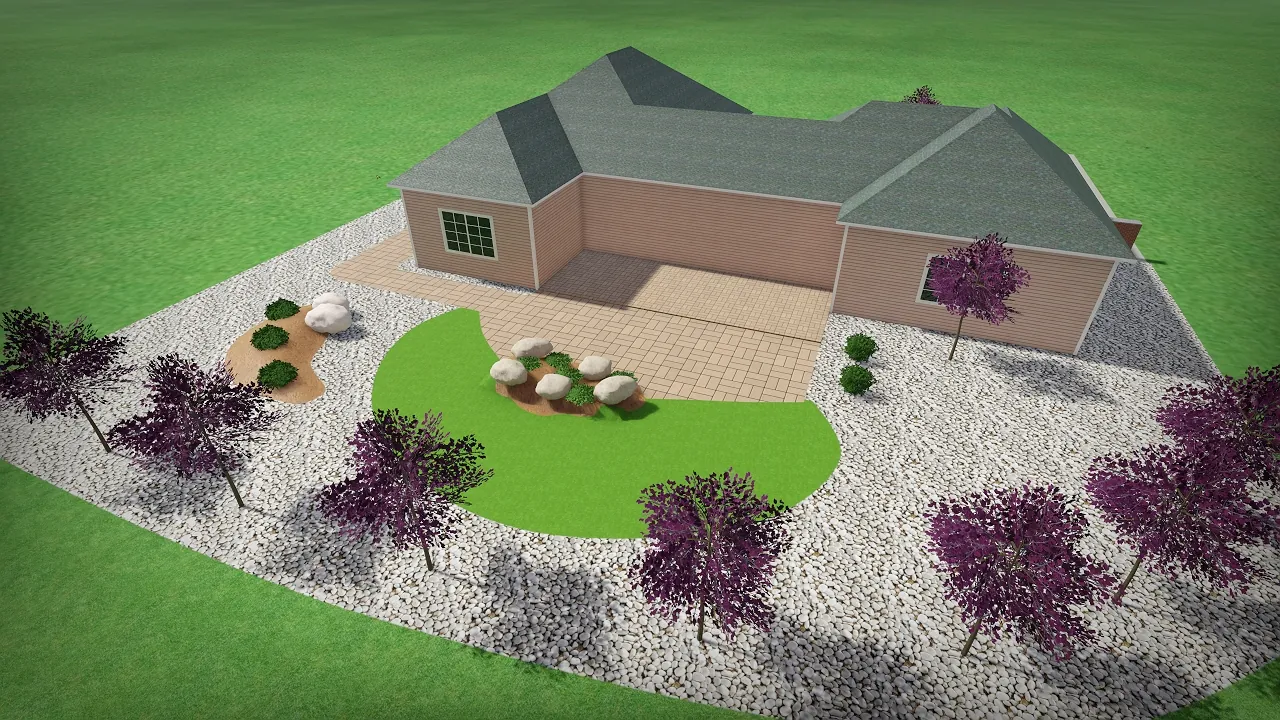
The best low maintenance front yard ideas Arizona homeowners use pair a clear layout with durable materials: gravel or decomposed granite as the main surface, a few well-set boulders, a solid entry walkway, crisp edging, drip irrigation on a timer and only a small turf panel if you want green. Plan zones first, then pick materials that stay put.
Key takeaways
- Low maintenance comes from layout decisions, not from covering everything in rock.
- Choose one main ground cover, lay it at the right depth and contain it with real edging.
- Boulders and a defined walkway give curb appeal that needs almost no upkeep.
- Keep any turf panel small, simple in shape and separated from gravel by a hard border.
- A pre-emergent plan and a drip system on a controller remove most weekend chores.
- Check HOA rules early and build in phases if the budget needs it.
What makes a front yard truly low maintenance in Arizona?
Most homeowners asking about low maintenance front yard ideas in Arizona picture a yard they can ignore. In practice, the yards that stay good-looking with the least effort are the ones where every surface has a job, every edge is defined and water goes only where it is needed. A front yard covered wall to wall in loose rock with nothing holding it in place can actually create more work than a thoughtfully planned one, because rock drifts into the walkway, weeds find every gap and the whole thing starts to look tired after one season.
Think of upkeep in terms of recurring tasks. A traditional lawn front yard asks for mowing, edging, fertilizing, overseeding and frequent watering. A well-designed low-water front yard reduces that list to a handful of jobs: a spring and late-summer weed check, an occasional rake of the gravel, a look at the drip lines a few times a year and light shaping of shrubs. The goal of this guide is to help you design for that short list from the start.
The three questions that shape every easy-care front yard
- How do people move through the space? Guests, delivery drivers and your own trips to the mailbox all need an obvious, firm path.
- What should someone notice from the street? One or two focal points beat a dozen small features that each need attention.
- Which parts need water? If you can answer “only the planting pockets,” your maintenance load drops sharply.
Answering those questions on paper before any material is ordered is the single biggest money and time saver in a front yard project. It is also exactly the kind of thinking our landscape design service in Prescott is built around.
Plan zones before you choose materials
A front yard usually breaks down into four zones: the arrival path, the frame around the house, the street edge and the open field in between. Sketching those zones, even roughly on graph paper or over a printed aerial photo of your lot, makes material choices almost obvious.
| Zone | Purpose | Easy-care treatment |
|---|---|---|
| Arrival path | Gets people from driveway or sidewalk to the door | Pavers, flagstone or compacted decomposed granite with a stabilizer |
| House frame | Softens the foundation line and windows | A narrow planting bed on drip, set back from the wall, topped with gravel |
| Open field | Fills the bulk of the yard | One gravel or rock type, a few boulders, optional small turf panel |
| Street edge | Defines the property and handles foot traffic and car doors | Durable rock or a paver band, no plants that hang over the curb |
Once zones exist, you can decide where water is allowed. In a typical easy-care plan, water reaches only the house frame and a few pockets in the open field. Everything else is hard surface or mineral cover that needs nothing from the irrigation system.
Measure sun and shade before you decide
Front yards that face south or west take the full force of the afternoon sun, and rock surfaces there hold heat into the evening. North-facing yards stay cooler and can hold frost longer in winter. Note where the house throws shade at different times of year; a planting pocket that is sunny in June may sit in shadow for much of January. Placing living elements where conditions are kindest means fewer replacements later.
Gravel, decomposed granite or rock: picking the ground plane
The ground plane is the material covering most of your front yard, and it sets both the look and the upkeep. In Arizona the main choices are crushed gravel, decomposed granite and larger river or cobble rock. Each behaves differently underfoot, under a rake and under a summer storm.
| Material | Look | Underfoot | Upkeep notes |
|---|---|---|---|
| Crushed gravel (about 3/4 inch) | Clean, uniform, many color choices | Firm enough for occasional walking | Easy to rake level; needs edging so it does not spread |
| Decomposed granite | Soft, natural, matches local granite soils | Packs down into a walkable surface | Can track indoors if unstabilized; stabilized versions hold better on paths |
| River rock or cobble | Bold texture, good for accent bands | Uneven, not for walking | Leaves and debris settle between stones; best in small doses |
| Mixed sizes in one area | Natural wash look | Varies | Harder to clean; use deliberately rather than by accident |
For most front yards, one main material plus one accent material is plenty. A field of crushed gravel with a band of larger rock under the roof drip line, for example, looks intentional and gives rain from the eaves somewhere to land without splashing soil around.
Depth matters more than people expect
Gravel laid too thin lets soil show through within a season, and weeds follow. As a general guide, small gravel and decomposed granite look and perform best at roughly two to three inches deep, while larger decorative rock needs a little more to cover well. Spreading the right depth once is far cheaper than topping up thin areas every year.
Color choices that age well
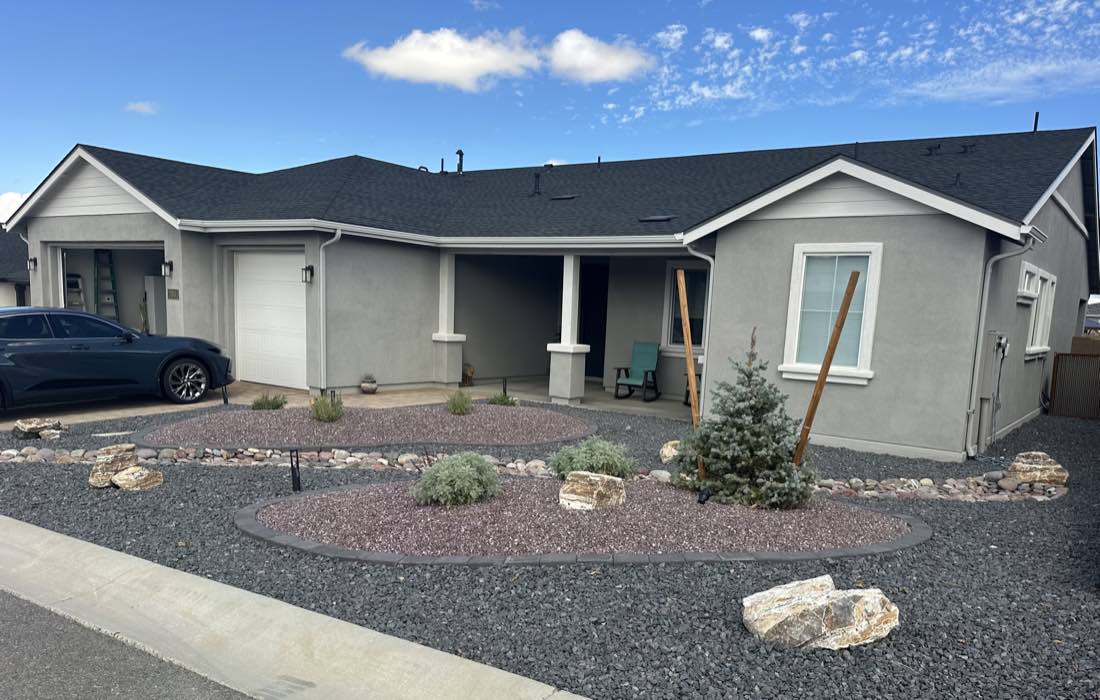
Very light rock can glare in strong sun and shows every leaf and drip of tire grime near the driveway. Very dark rock heats up quickly. Mid-tone browns, tans and muted reds tend to blend with the hills around Prescott and hide dust between rakes. Bring a few samples home and look at them in both morning and late-afternoon light before committing.
Boulders and gentle grade changes that do the visual work
A flat field of gravel reads as unfinished. Boulders, set in small groupings, give the eye somewhere to rest and make a front yard look designed rather than covered. Better still, a boulder needs no water, no trimming and no replacement.
- Group in odd numbers. A cluster of three, with one clearly larger, looks more natural than a row of matching stones.
- Bury them partly. A boulder sitting on top of the gravel looks dropped there. Setting the base below grade makes it look like it has always been part of the land.
- Face the best side to the street. Most stones have a more interesting face; turn it toward the people who will see it.
- Use them to solve problems. A boulder at a walkway corner stops shortcuts across the gravel; one near the driveway apron keeps tires off the planting bed.
Low mounds, sometimes called berms, can also break up a flat lot and give a planting pocket a slight lift. Keep mounds gentle and wide so gravel stays put, and make sure they do not push water toward the house. If your front yard already has a real slope, a short low wall may hold it better than a mound; our retaining wall team can tell you which approach fits.
An entry walkway that does the guiding
A front walkway is the one part of the yard that gets used every single day, so it deserves the most durable material in the plan. When the path is obvious and comfortable, people stop cutting across gravel and planting beds, which keeps those areas neat without any extra effort from you.
Width, shape and material
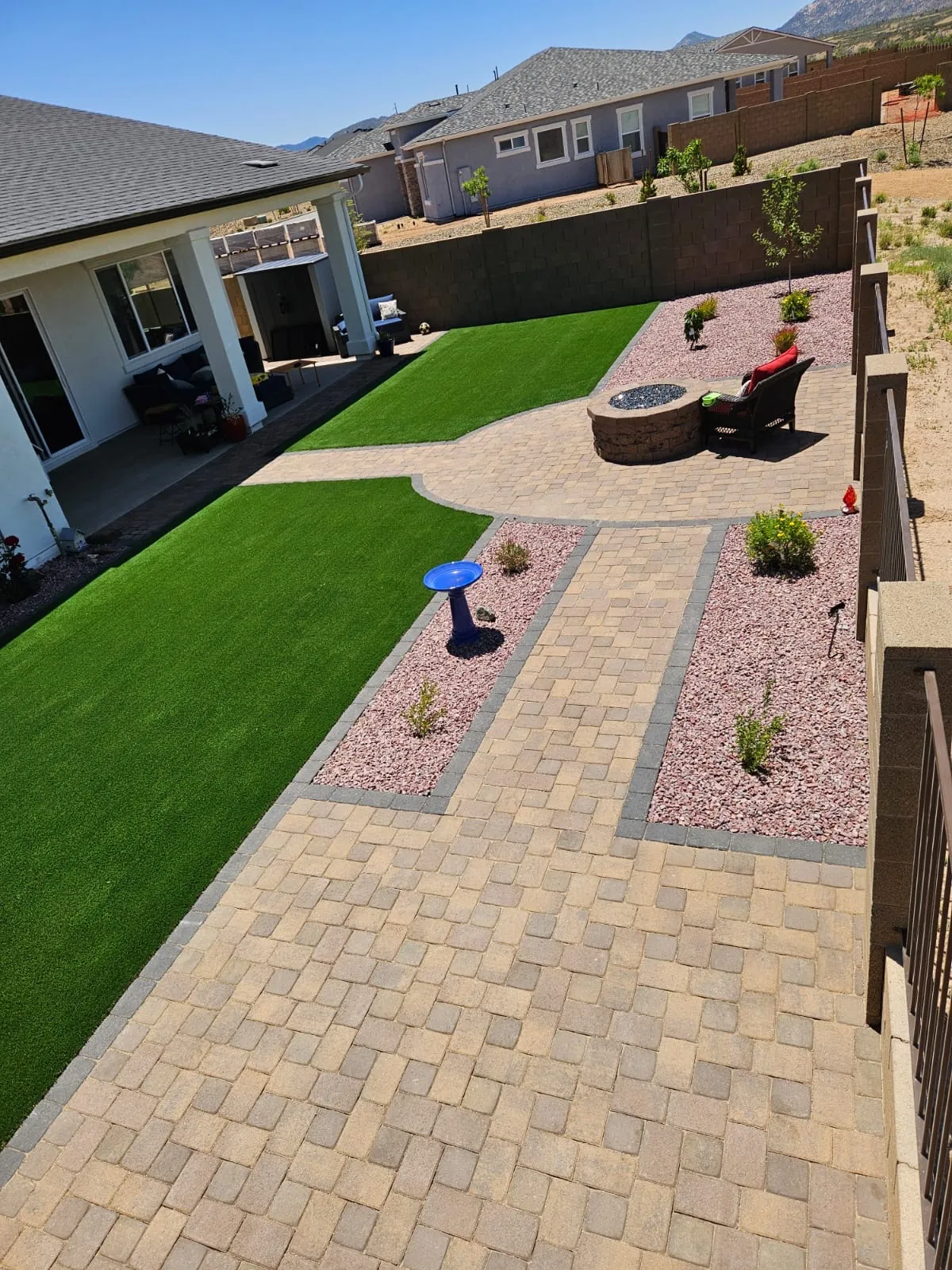
A path that feels generous invites use. Many designers aim for roughly four feet so two people can walk side by side, narrowing for secondary paths to a side gate. Gentle curves are welcoming, but a path that wanders too much will be ignored; people take the shortest line to the door. Interlocking pavers, flagstone set on a compacted base and stabilized decomposed granite all work well. Pavers hold a crisp edge for years and are easy to repair one unit at a time, which is why many of the entry walks we build through our paver and hardscape service use them.
Lighting and the approach at night
If your front door is approached after dark, plan for low path lighting before the walkway is built. Running conduit under the path during construction is simple; cutting it in later is not. Even a few fixtures at the steps and the turn toward the door make the approach safer and show off the yard in the evening.
Mind the mailbox and the trash can route
Two trips get forgotten in many front yard plans: the walk to the mailbox and the route for wheeling trash bins to the curb. Give both a firm surface. Bins rolled across loose gravel scatter it every week, and that is exactly the kind of small recurring chore a good layout removes.
Where a small turf panel earns its place
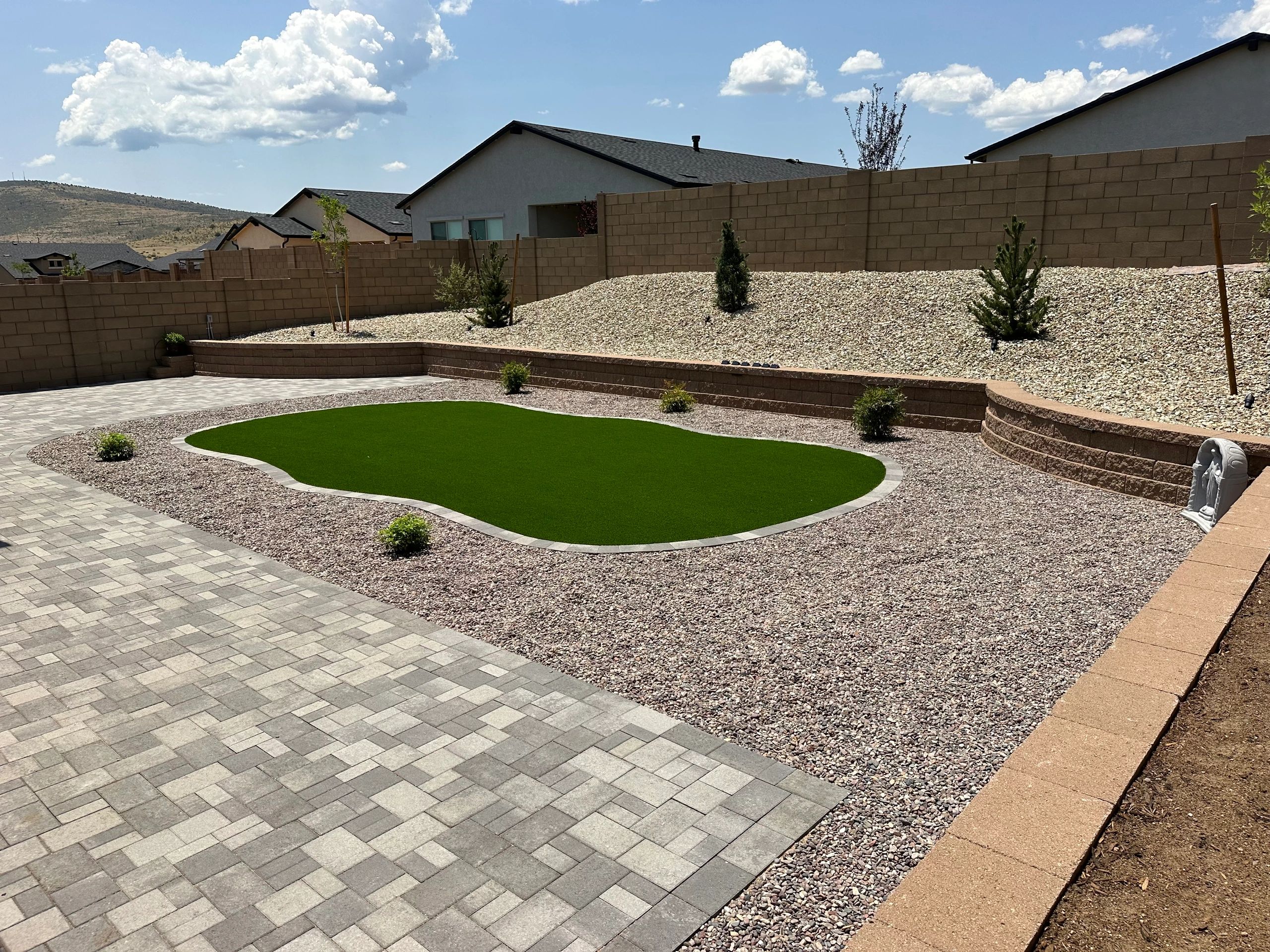
Many families still want a patch of green out front, for kids, a dog or simply for contrast against the rock. The low-maintenance answer is to keep any turf area small, simple in outline and surrounded by a hard border. A rectangle or soft oval is easier to install and cleaner to keep than a shape with many tight curves.
Synthetic turf removes mowing and watering from the list entirely, and modern products look convincingly natural. It still benefits from a periodic rinse and brushing, and in full afternoon sun the surface can get warm, so placement near shade or a north wall helps. Our artificial turf installation team can walk you through product choices and base preparation for your lot.
Separate turf from gravel with a hard edge
Gravel that migrates onto turf gets kicked into the fibers and is tedious to pick out. A paver band, concrete curb or steel edge between the two surfaces solves that permanently and gives the turf a finished frame.
Edging and weed control: the two jobs that decide your upkeep
If there is one section of this guide to take seriously, it is this one. Most front yards that start out low maintenance and slowly become a chore fail in exactly two places: materials that migrate because nothing holds them, and weeds that move into every bare spot.
Edging that actually holds
- Steel or aluminum edging gives a thin, crisp line and holds gravel well when staked properly.
- Concrete curbing is permanent and handles mower-free yards nicely, but it is hard to change later.
- Paver or brick bands double as a decorative border and a mowing strip if you keep any living lawn.
- Plastic roll edging is inexpensive but tends to heave and wander, especially through freeze and thaw cycles; it is usually a false economy.
Whatever you choose, set the edge slightly above the gravel surface so rock does not spill over, and run it everywhere two materials meet.
A realistic weed strategy
No front yard in Arizona is weed-free forever; wind and birds deliver seed constantly. The trick is to stop most weeds before they sprout and pull the rest while they are tiny.
- Clear and prepare the soil well before any rock goes down. Existing perennial weeds should be removed, roots included.
- Decide on fabric deliberately. A quality permeable fabric under gravel can help in open areas, but it does not belong under planting pockets long term, and windblown soil can still settle on top of it over time.
- Use a pre-emergent product as labeled, typically timed before the main germination flushes. Follow the product label exactly and keep it away from areas where you intend to sow seed.
- Walk the yard after storms. Rain triggers germination. Pulling seedlings within a week or two of a good rain takes minutes; waiting a month takes an afternoon.
If you would rather not think about any of this, a light seasonal visit from our yard maintenance crew in Prescott Valley covers weed checks, gravel raking and shrub shaping on a schedule.
Drip zones and a controller that adjusts itself
Even the most mineral-heavy front yard usually has some living plants, and how they are watered determines whether they thrive with no attention or demand constant fiddling. Drip irrigation delivers water directly to each root zone, keeps the gravel surface dry and wastes far less than spray heads, which also means fewer weeds sprouting in wet rock.
Set up zones by need, not by location
Group plants with similar water needs onto the same valve. A shrub that wants a deep drink once a week should not share a line with a succulent that prefers to dry out. Separating them is easy at installation and nearly impossible to fix without digging later. Our irrigation and xeriscaping team lays out zones this way on every project.
Let the controller do the seasonal thinking
A basic timer runs the same schedule all year, which overwaters in winter and can underwater in the dry weeks before the summer rains. A weather-based or soil-moisture controller adjusts automatically. The EPA’s WaterSense program labels irrigation controllers that meet its efficiency criteria, which is a useful filter when shopping. Pair a smart controller with a quick visual check of the emitters a few times a year and the system will largely run itself.
Protect the lines during installation
Drip tubing should be buried or covered beneath the gravel, not left lying on top where sun degrades it and rakes snag it. Before any trench is dug, contact Arizona 811 so buried utilities in the front yard are marked; this is especially important near the street, where service lines usually run.
HOA rules and a phased budget
Many planned neighborhoods in the area have homeowners associations, and front yards are the part of the property they care about most. Before you finalize a plan, read the architectural guidelines and find out whether a submittal is required. Common topics include the percentage of the yard that must be planted, approved rock colors, turf rules, boulder sizes and how close plants may be to the sidewalk. Getting approval on a clear drawing first avoids having to undo work later.
Building in phases without making extra work
A front yard does not have to be finished in one go. The key is to install things in an order that never requires tearing out what is already done.
- Phase one: grading, utilities and irrigation sleeves. Anything that runs underground goes in first, including conduit for future lighting.
- Phase two: walkway and edging. These define the layout and hold everything else in place.
- Phase three: boulders and ground cover. Large stones go in before gravel so the gravel can be fitted around them.
- Phase four: plants, turf panel and finishing touches. These are the easiest pieces to add or change over time.
Laying out the full design at the start, even if you build it over a couple of seasons, keeps every phase pointing toward the same finished yard. If you want to see how completed projects come together, browse our project gallery.
Low maintenance front yard mistakes to avoid
Run through this checklist before signing off on any plan. Each item is a common reason an easy-care yard turns into a regular chore.
- Spreading rock too thin, so soil and weeds show through within a year.
- Skipping edging, or using flimsy edging that heaves in the cold.
- Putting gravel right against the house siding without leaving a clean, inspectable band at the foundation.
- Choosing a turf shape with lots of tight curves that are hard to install and trim.
- Running one irrigation zone for every plant regardless of need.
- Planting shrubs that will outgrow their space and need constant cutting back near walkways and windows.
- Leaving no firm route for trash bins and mail trips.
- Laying everything in a single flat plane with no boulders, mounds or focal point, which makes even a clean yard look unfinished.
- Ignoring the HOA until after installation.
- Letting drip tubing sit exposed on top of the rock.
Avoiding these ten mistakes will do more for your long-term upkeep than any single material choice.
Front yard notes from Prescott Valley to Chino Valley, Prescott and Dewey-Humboldt
Front yards in our part of Yavapai County deal with conditions that low-desert advice does not always cover. At roughly 5,000 to 5,400 feet, homes in Prescott and Prescott Valley see real winter freezes, large swings between day and night temperatures, dry spring winds and heavy summer storms. That is why firm edging, deep enough gravel and a well-built walkway base matter so much here: materials that look fine in a mild climate can shift and heave after a few cold snaps.
Lot sizes vary a lot across the area too. Many neighborhoods in Prescott Valley have compact front yards where a single walkway, a boulder grouping and a small planting bed make the whole statement. Out toward Chino Valley and Dewey-Humboldt, larger and more rural lots often benefit from defining a manageable “finished” area near the house and letting the outer acreage stay natural. For plant selection advice specific to the region, the Yavapai County office of the UArizona Cooperative Extension is a trusted local resource.
Want a front yard that looks sharp and asks very little of you?
We design and build easy-care front yards throughout the Prescott area and greater Yavapai County, from the first sketch to the final rake of gravel. Reach our office at (928) 848-0706 or tell us about your front yard to book a free estimate. We work under Arizona license ROC 336502 with bond and insurance in place; check the license yourself on the Arizona Registrar of Contractors site.
Low Maintenance Front Yard FAQ
How deep should decorative rock be in a front yard?
Small crushed gravel and decomposed granite usually look and work best at about two to three inches deep. Larger decorative rock needs a bit more depth to cover the soil completely. Rock spread too thin lets dirt show through, invites weeds and soon needs topping up, so laying the full depth at installation saves money and effort over the life of the yard.
Is landscape fabric worth using under gravel in Arizona?
It can help in open gravel areas with no plants, because it slows weeds coming up from below and keeps rock from mixing into the soil. It is not a permanent fix, since windblown dust settles on top over time and seeds can sprout there. Avoid long-term fabric under planting pockets, where it can restrict roots and water.
What size of turf panel makes sense in a small front yard?
Keep it just large enough for how you will use it, such as a play spot, a place for a dog or simple green contrast. A compact rectangle or gentle oval usually looks best and is easiest to install and keep tidy. Surround it with a firm border so gravel cannot drift onto the fibers.
Do I need HOA approval before changing my front yard?
If your home is in an HOA community, most likely yes. Many associations require a drawing and material list before front yard work begins and set rules on rock colors, planted percentages and turf. Read your architectural guidelines first, submit a clear plan, and wait for written approval before any work or material deliveries start.
How wide should a front walkway be?
Around four feet is a comfortable width for a main entry walk because two people can walk side by side and the path looks proportionate to most homes. Secondary paths to a side gate or utility area can be narrower. If anyone in the household uses a wheelchair or walker, plan for extra width and gentle slopes.
What edging keeps gravel out of the walkway and turf?
Steel or aluminum edging, concrete curbing and paver bands all hold gravel reliably when they sit slightly above the rock surface. Thin plastic roll edging is cheaper but often lifts and shifts through winter freezes. Install edging wherever two materials meet, especially between gravel and walkways or turf.
How can I make a rock front yard look less plain?
Add structure rather than more rock. A grouping of partly buried boulders, a gentle mound, a clearly defined entry path and one accent band of contrasting stone give the eye places to land. A few well-placed plants in pockets near the house soften the look without adding much upkeep.
How much time does a low maintenance front yard need each month?
A well-planned front yard usually needs only occasional attention: pulling a few weeds after rain, a light rake of the gravel and a quick look at drip emitters. Shrubs may need shaping once or twice a year. Time depends on yard size and plant count, so keep living areas small if you want the lightest workload.
Should front yard boulders be partly buried?
Yes. Setting a boulder with its base below the finished grade makes it look natural and stable, as if it belongs to the land. A stone resting on top of the gravel looks placed and can shift. Turn the most attractive face toward the street and group stones in odd numbers for a relaxed, natural look.
What should I build first if my front yard budget is limited?
Start with what goes underground and what defines the layout: grading, irrigation sleeves, conduit for any future lighting, the main walkway and edging. Those pieces are hardest to add later. Boulders, ground cover, plants and a turf panel can follow in later phases without tearing out finished work.