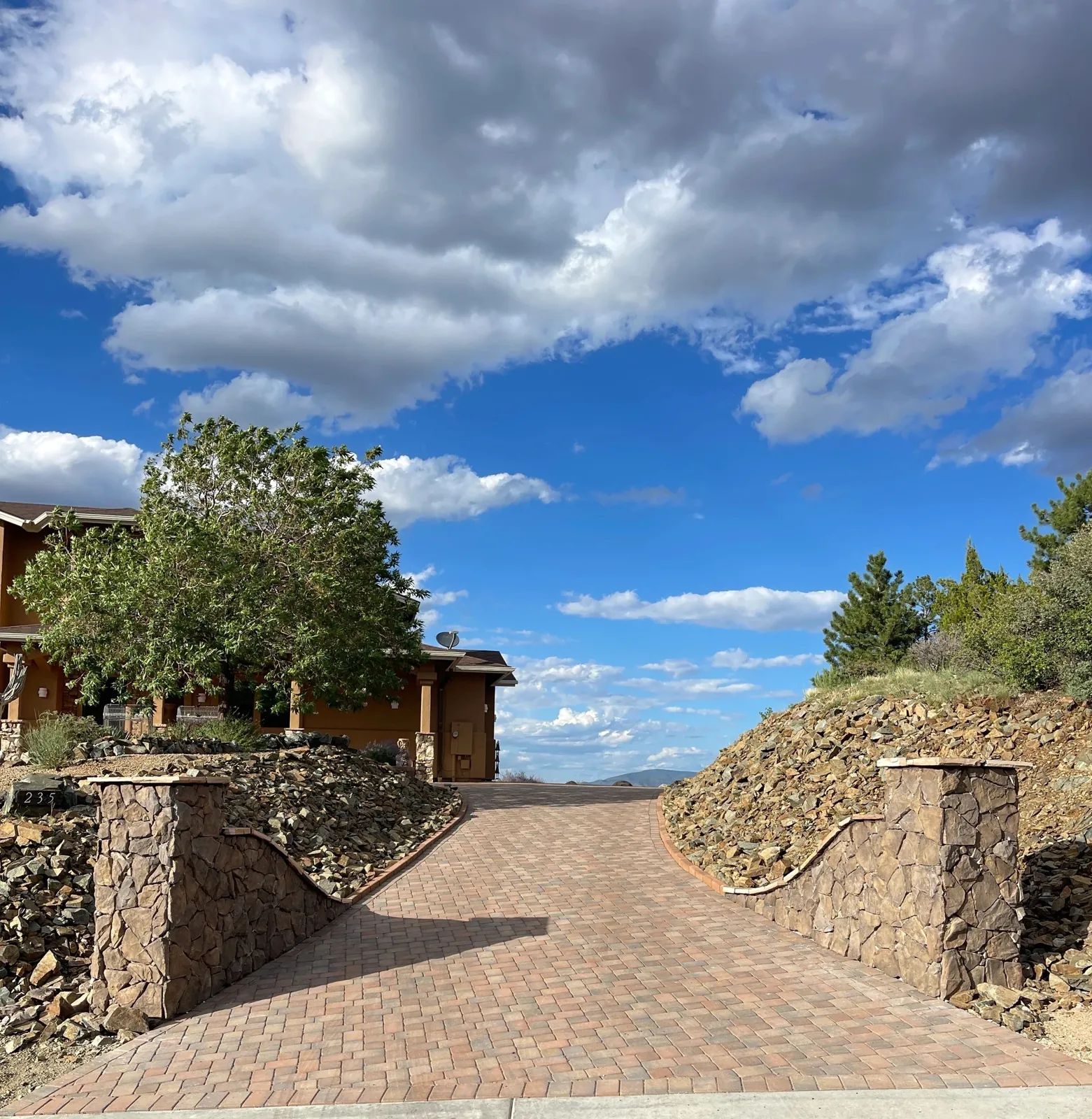
Solid monsoon yard drainage Prescott homes can depend on comes down to one goal: move storm water away from your home before it can pool, erode or seep. That means grading soil so it falls away from the foundation, sending roof water well clear of the house, and giving runoff a planned path such as a swale, dry creek bed or French drain.
Key takeaways
- Most of Prescott’s yearly rain arrives in a few intense July–September storms that fall on ground baked hard by a dry May and June.
- Correct grading is the cheapest and most important fix: aim for at least 6 inches of fall in the first 10 feet away from the foundation where the lot allows.
- Roof runoff is concentrated water. Downspouts need extensions, splash zones or a buried line that releases it far from walls and walkways.
- Surface solutions (swales, dry creek beds, permeable ground) handle most yards; buried French drains are for stubborn wet spots and subsurface water.
- Slopes and retaining walls need their own drainage plan, or water pressure and erosion will undo the work.
- A short pre-monsoon checklist in June prevents most storm-day surprises.
Why do monsoon storms overwhelm high-desert yards?
Prescott sits at roughly 5,400 feet, and its rain does not arrive evenly. Long-term weather normals put the city’s average yearly precipitation near 16.5 inches, yet May and June together usually deliver well under an inch. Then the North American monsoon sets in, and July and August each average close to three inches on their own. Much of that comes in short, heavy cloudbursts rather than gentle all-day showers.
That timing is the root of most drainage trouble we see. After weeks of sun, bare soil develops a crust that sheds water instead of absorbing it. When a thunderstorm drops a large amount of rain in twenty or thirty minutes, the water has nowhere to go but sideways. It follows whatever low line it can find: along a foundation, across a patio, down a side yard or straight through a planting bed, carrying gravel and topsoil with it.
Lots in this area add their own complications. Many homes in Prescott and the surrounding communities are built on sloped ground, and soils vary from fast-draining granite-derived grit to compacted fill left by construction equipment. Two neighboring yards can behave completely differently in the same storm. The National Weather Service office in Flagstaff, which forecasts for Yavapai County, publishes useful monsoon safety and season information if you want to understand what drives these storms.
The good news is that monsoon water behaves predictably once you watch it. Water always seeks the lowest available path. A drainage plan simply decides that path in advance so the storm does not choose it for you.
What are the warning signs your yard is not draining?
The best time to study drainage is during or right after a real storm. Put on a rain jacket, walk the property and look for these clues. If you miss the storm, the evidence usually stays visible for days.
- Standing water near the house that lingers more than an hour or two after rain stops.
- Soil or gravel washed onto walkways, patios or the driveway, leaving fan-shaped deposits.
- Channels cut into beds or bare soil, especially below downspouts and at the bottom of slopes.
- Stains or efflorescence (white, chalky residue) on stem walls, block walls or the lower edge of stucco.
- Exposed footing or settling where soil has eroded away from the base of the house or a wall.
- Musty smells or damp spots in a crawl space, garage or basement after storms.
- Gravel migrating into one corner of the yard or piling against a fence line.
- Plants that drown in one bed while others nearby stay healthy, a sign water is collecting in a pocket.
Take photos with the date showing. A few storm-day pictures are far more useful to a designer than a description, because they show exactly where water enters the property, where it slows and where it leaves.
How does grading fit into monsoon yard drainage in Prescott?
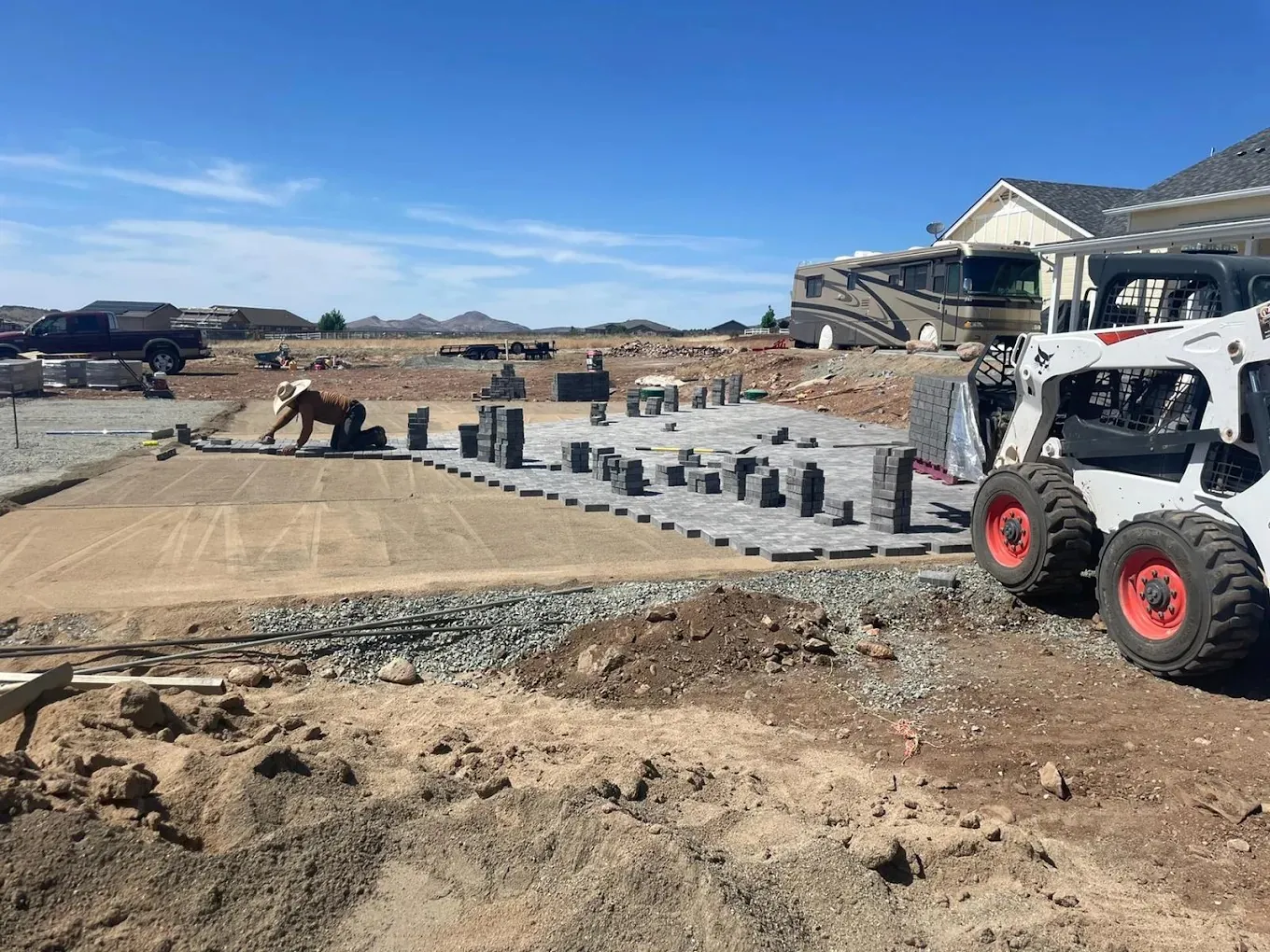
Grading is the shape of the ground, and it decides where every drop goes. Before investing in pipes or rock channels, confirm that the soil around your home falls away from it. A common building-code benchmark is at least 6 inches of fall within the first 10 feet from the foundation. On tight lots where that is not possible, a shallow swale can be shaped to carry water around the house instead.
How to check your grade
- Drive a stake at the foundation and another about 10 feet out.
- Run a string between them and level it with a line level.
- Measure from the string down to the soil at each stake. The outer measurement should be at least 6 inches greater than the one at the house.
- Repeat on every side of the home, including narrow side yards that are easy to forget.
Common grading problems we correct
Settled backfill. Soil placed against a new foundation often settles over the first few years, creating a moat that holds water right where you least want it.
Beds built up against the wall. Raised planting beds, extra gravel or mulch piled against stucco can reverse the slope and bury weep screeds that need to stay exposed.
Hardscape that tilts the wrong way. A patio or walkway poured or laid flat, or pitched toward the house, delivers water to the foundation every time it rains. Patios should carry a gentle pitch away from the home, which is something we build into every paver installation from the base up.
Block walls acting as dams. Perimeter walls common in Prescott Valley subdivisions can trap water in a backyard unless the wall has weep openings or the grade is shaped to a planned outlet.
Regrading is often done with small equipment and careful hand work. Any time digging is involved, the first step is a locate request through Arizona 811 at least two full working days ahead so buried utilities are marked.
How should roof runoff and downspouts be handled?
A roof gathers rain from a large area and dumps it out of a handful of downspouts. During a monsoon cell, each downspout can act like an open hose aimed at your foundation. Getting that water away from the house is one of the highest-value improvements in any drainage plan.
Options from simplest to most involved
- Extensions and splash blocks. The minimum. Extend discharge several feet from the wall onto a splash block or rock pad so falling water does not dig a hole.
- Rock splash zones. A shaped bed of cobble or angular rock that absorbs the energy of the water and spreads it out. It also looks intentional rather than improvised.
- Connection to a dry creek bed or swale. The downspout feeds directly into a designed channel that carries water to a safe outlet.
- Buried solid pipe. The downspout connects to a smooth-walled pipe below grade that releases water at a pop-up emitter or daylight outlet farther down the yard. This keeps walkways clear and is useful where space is tight.
Two details make or break a buried downspout line. First, it needs steady fall along its entire length, or it will hold standing water and debris. Second, it needs a clean-out or accessible inlet so pine needles, leaves and grit can be flushed out. Gutters themselves should be cleared before each monsoon season, because an overflowing gutter defeats every downspout improvement below it.
What are the best surface drainage solutions for monsoon storms?
Most yards in the Prescott area can be managed with surface drainage, meaning water stays on top of the ground but follows a designed route. Surface systems are easy to inspect, simple to maintain and fit naturally into desert-style landscapes.
Swales
A swale is a broad, shallow channel shaped into the ground. It may be lined with gravel, planted, or simply left as compacted soil. Swales slow water down and guide it gently, which also gives some of it time to soak in. They work well along side yards and at the base of slopes.
Dry creek beds
A dry creek bed is a rock-lined channel that looks like a natural wash for most of the year and carries water during storms. Done properly, it uses a mix of rock sizes, larger stones on the edges and outside bends, and a fabric or compacted base where needed to keep the channel from scouring. A creek bed is one of the most popular ways to turn a drainage problem into a landscape feature, and it pairs naturally with low-water planting along its banks. You can see how we blend rock, gravel and planting in our xeriscaping and irrigation work.
Permeable ground covers
Where possible, let water soak in rather than run off. Open gravel areas, planting beds with good soil structure and thoughtfully designed hardscape layouts all reduce the volume that has to be moved. Every square foot of hard surface you add increases runoff, so drainage should be considered in the same conversation as any new patio, walkway or turf area.
| Option | Best for | Visibility | Upkeep |
|---|---|---|---|
| Regrading | Water flowing toward the house | Invisible once planted | Check yearly for settling |
| Downspout extension or splash zone | Concentrated roof water | Low | Keep outlets clear |
| Swale | Guiding sheet flow around buildings | Subtle dip in the ground | Remove sediment after storms |
| Dry creek bed | Larger flows and visible channels | A landscape feature | Reset displaced rock occasionally |
| French drain | Persistent wet spots, subsurface water | Hidden below grade | Flush outlet, watch for clogging |
| Buried solid pipe | Moving downspout water past walkways | Hidden except outlet | Clean inlet screens |
When is a French drain the right call?
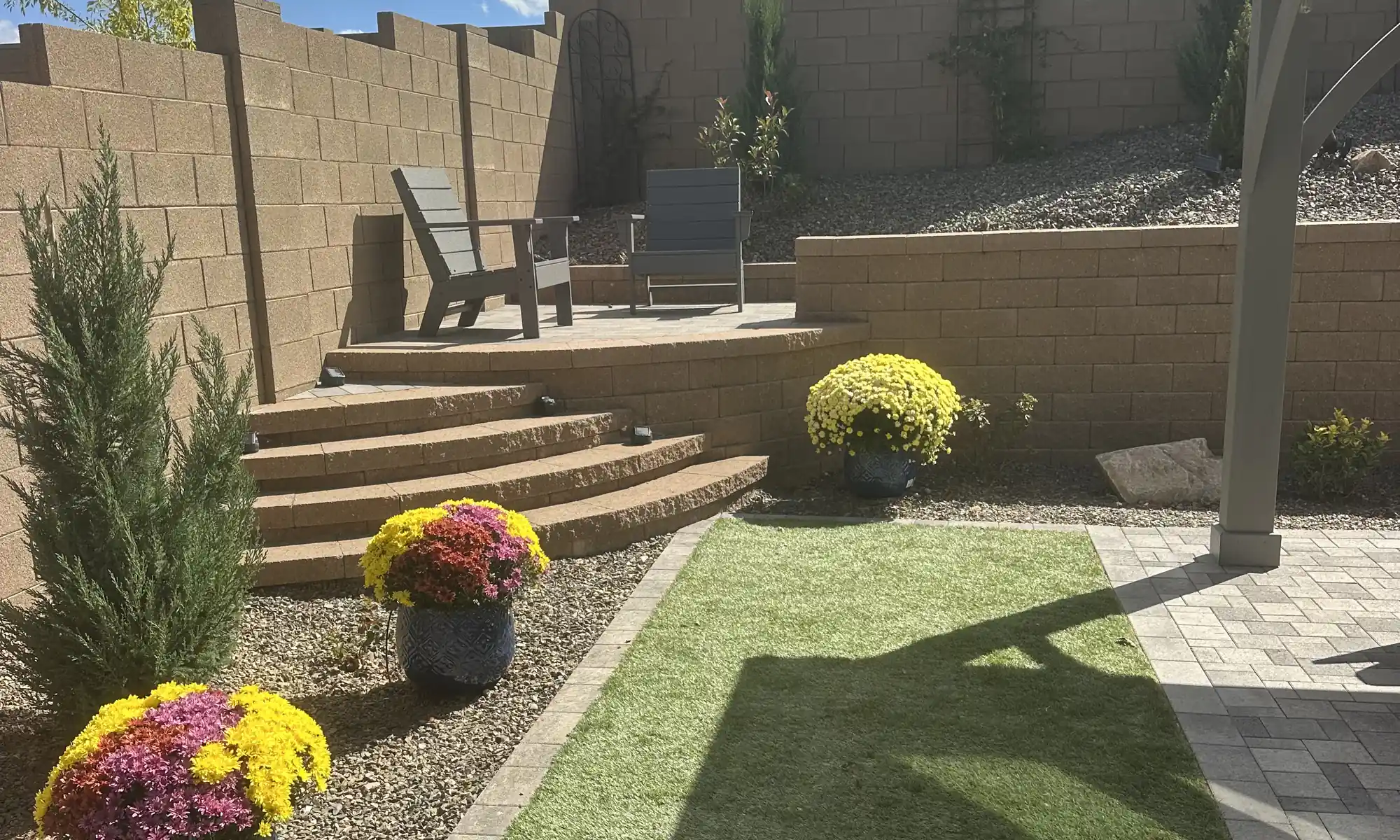
A French drain is a gravel-filled trench, usually with a perforated pipe in the bottom, that collects water below the surface and carries it away. It is a strong tool, but it is not the first one to reach for. If surface water is simply running toward the house, regrading or a swale usually solves it with less digging and less maintenance.
French drains earn their place in situations like these:
- A low spot stays soggy long after storms even though the grade around it looks correct.
- Water moves through the soil from an uphill neighbor or slope and surfaces in your yard.
- There is no room for a visible channel, such as a narrow side yard between a house and a block wall.
- Water needs to be collected behind a structure, such as the back of a retaining wall.
The details matter. The trench needs consistent fall to an outlet that can actually accept the water. Clean, washed gravel and a filter fabric wrap help keep fine soil from clogging the system over time. And the outlet must discharge somewhere safe on your own property or to an approved location, never onto a neighbor. A French drain with no good outlet simply becomes an underground bathtub.
Because French drains are buried, they are hard to inspect. We recommend leaving a clean-out at the upper end so the line can be flushed with a hose, and checking the outlet after the first few storms to confirm water is flowing out the way it should.
How do slopes, erosion and retaining walls affect drainage?
Sloped lots are common across Yavapai County, and they magnify every drainage issue. Water speeds up as it travels downhill, and fast water carries soil. Over several monsoon seasons, an unprotected slope can lose a surprising amount of ground, undermining fences, walkways and the edges of patios.
Ways to slow water on a slope
- Terracing breaks a long slope into shorter, flatter steps so water never builds up much speed.
- Rock armoring with larger angular stone on steep sections and in channels resists scouring.
- Check structures, such as low rock lines across a swale, slow water and drop sediment before it reaches the bottom.
- Ground cover, whether planting or a properly placed rock blanket, protects bare soil from the impact of heavy drops. General erosion control principles apply here: cover the soil and slow the water.
Drainage behind retaining walls
A retaining wall holds back soil, and when that soil is saturated it becomes much heavier and pushes harder on the wall. That is why a well-built wall includes drainage behind it: free-draining gravel backfill, a perforated collection pipe at the base where the design calls for one, and a way for the collected water to exit. Walls built without this often lean, bulge or crack after a few wet seasons. If you are planning a wall to tame a slope, our retaining wall builds treat drainage as part of the structure, not an add-on.
The top of the wall needs attention too. Grade the area above so water does not pour over the cap in a sheet, and consider a shallow swale behind the wall to intercept runoff before it soaks into the backfill.
Can you put monsoon water to work instead of just moving it?
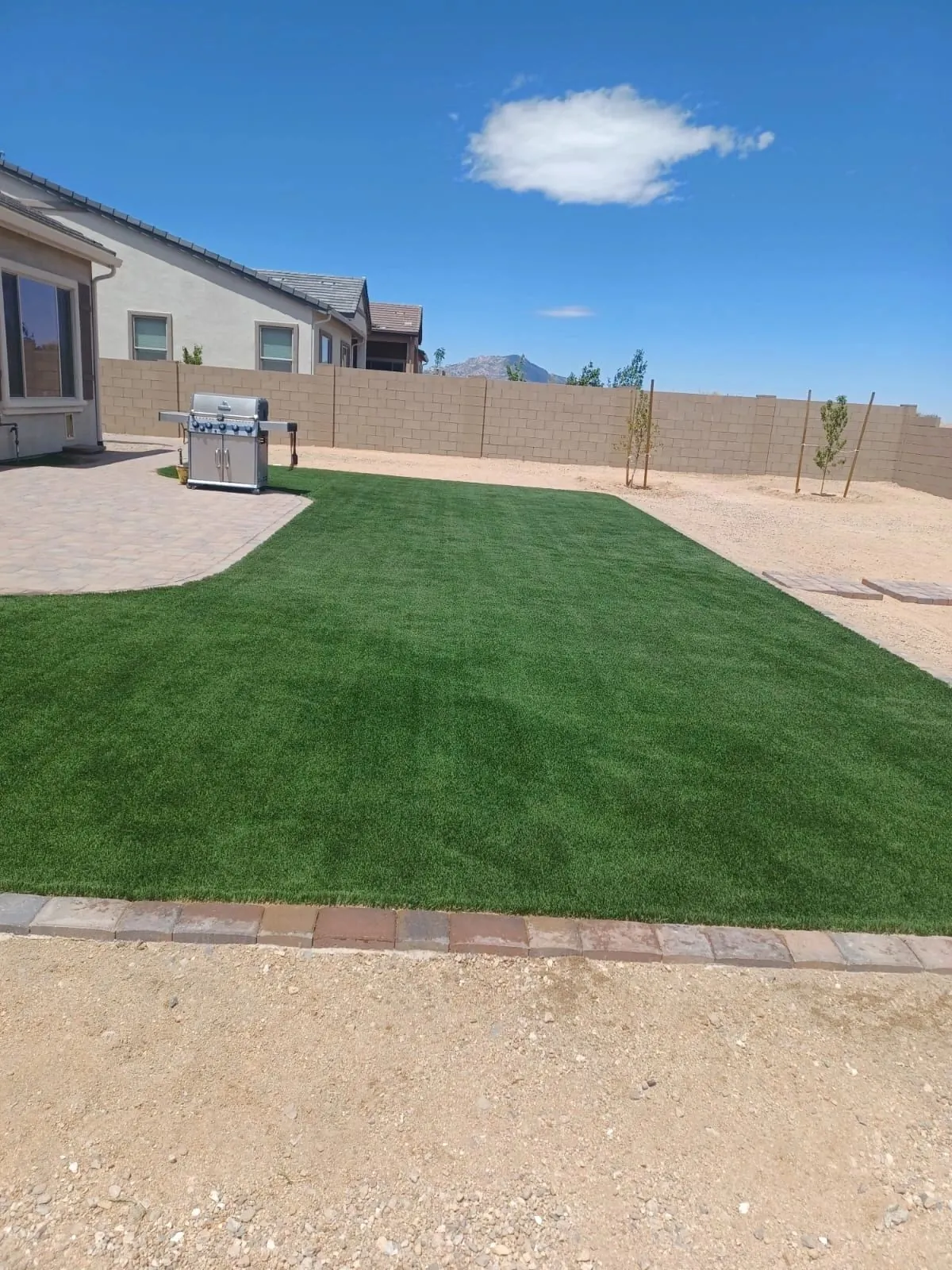
Getting water away from the house does not mean wasting it. In a region where spring is so dry, many homeowners like the idea of capturing some summer rain for later. There are two broad approaches.
Passive harvesting shapes the landscape so runoff is directed into planted basins away from structures. A swale or creek bed can end in a shallow, rock-lined basin around trees or shrubs, letting water soak in where roots can use it. This needs no tanks or pumps, only good grading and a safe overflow route for big storms.
Active harvesting collects roof water in barrels or tanks for later use on plants. It works best when the tank is sized realistically, screened against mosquitoes and debris, and fitted with an overflow that connects to the rest of the drainage system. Check any homeowners association rules about visible tanks before installing one.
Either way, the harvesting feature must sit well away from foundations and must always have a planned overflow. A monsoon storm can fill a basin or barrel quickly, and the extra water still needs somewhere safe to go. Harvested water also pairs well with efficient drip zones, which our yard maintenance visits can help keep tuned through the season.
What should be on a pre-monsoon drainage checklist?
Early to mid-June, before the first storms, is the ideal time to walk through this list. Most items take an afternoon and cost little.
- Clean gutters and confirm every downspout is attached and discharging away from the house.
- Check that downspout extensions, splash blocks and pop-up emitters are in place and not buried.
- Rake sediment and debris out of swales, creek beds and drain inlets.
- Flush buried drain lines with a hose and make sure water appears at the outlet.
- Look for soil or mulch piled against stucco or siding and pull it back to restore slope and expose weep screeds.
- Clear weep holes or openings at the base of block walls so trapped water can exit.
- Re-seat any rock that shifted out of channels or splash zones during last season.
- Inspect the base of slopes and retaining walls for new cracks, bulges or erosion.
- Make sure patio and walkway edges have not settled into a lip that holds water.
- Take a few reference photos so you can compare after the first big storm.
After each significant storm, do a quick follow-up walk. Note anything that moved, overflowed or pooled. Small corrections made in July prevent large repairs in September.
How drainage differs in Chino Valley, Dewey-Humboldt, Prescott and Prescott Valley
Each community we serve brings its own drainage pattern. In Prescott, hillside homes and boulder-strewn lots near granite outcrops often need terracing and armored channels to handle fast-moving water. In Prescott Valley, sitting around 5,060 feet, many backyards are enclosed by block walls, so the key question is how water exits the yard without pooling against the wall or the patio.
Out in Chino Valley, larger and more open parcels can receive runoff from neighboring land, and long driveways or arena areas may need broad swales and culvert-style crossings. Homes in Dewey-Humboldt often sit near natural washes, where the priority is protecting structures and access while letting the wash keep doing its job.
Whatever the setting, a good drainage plan starts with a site visit during or shortly after rain when possible, a look at where water enters and leaves the property, and a design that fits the rest of the landscape. We would rather build one well-placed creek bed than three patches that fight each other. Browse our project gallery to see grading, walls and rock work on finished yards.
Worried about this year’s storms? Our crew can walk your property, trace where the water goes and design a drainage fix that also looks good. Call (928) 848-0706 or request your free estimate online. Our license number is ROC 336502, we carry bond and insurance, and anyone can verify the license through the Registrar of Contractors site.
Monsoon yard drainage: frequently asked questions
When does monsoon season usually reach the Prescott area?
The heaviest monsoon rain around Prescott typically falls from July through September, with July and August each averaging close to three inches. Storms can start in late June in some years. Because May and June are usually the driest months, it makes sense to finish drainage checks and repairs in early June, before the ground starts taking hard afternoon downpours.
How much should the ground slope away from my foundation?
A widely used benchmark is at least 6 inches of fall within the first 10 feet from the foundation. Where a property line, wall or neighboring house makes that impossible, a shallow swale can be shaped closer to the house to carry water around it instead. The aim is simply that no water ever sits against the stem wall.
Is a dry creek bed or a French drain better for my yard?
It depends on where the water is. If runoff travels across the surface during storms, a dry creek bed or swale is usually the better choice because it is visible, easy to maintain and doubles as a landscape feature. A French drain suits wet spots that stay soggy below the surface or narrow areas with no room for a channel.
Where should downspout water be sent?
Send it several feet away from the house at minimum, onto a rock splash zone, into a designed channel, or through a buried solid pipe to an outlet farther down the yard. The discharge point should drain away from walkways and the foundation, stay on your own property, and have enough rock to stop the falling water from digging a hole.
Can decomposed granite or gravel wash away during monsoon storms?
Yes. Loose gravel and decomposed granite on a slope or in a flow path can migrate during heavy rain. Using larger angular rock in channels, adding edging, compacting stabilized surfaces properly and directing concentrated water around rather than across gravel areas all reduce washouts. Re-raking after big storms is normal upkeep for loose materials.
Do I need to call Arizona 811 before installing a drainage system?
Yes. Before anyone trenches, regrades, lays pipe or shapes a creek bed, an Arizona 811 locate request needs to go in, giving the utilities two or more full working days to mark their lines. Utilities such as gas, electric, water and communication lines can be shallower than people expect, and marking them first protects both the crew and the household.
Can I send my yard’s runoff toward the street or my neighbor’s lot?
You should never redirect concentrated runoff onto a neighbor’s property; it can damage their yard and lead to disputes. Releasing water toward the street may or may not be acceptable depending on local rules and how your lot is laid out. A good plan keeps water on your property where possible, slows it down and spreads it out before it leaves.
What signs show water is collecting against my foundation?
Look for puddles that stay next to the house after rain, white chalky residue or dark staining at the base of stucco, soil that has washed away to expose footing, and damp or musty areas in a crawl space or garage. Any of these after a storm suggests the grade or roof drainage needs correcting before the next one.
Is rainwater harvesting worth it with only about 16 inches of rain a year?
It can be, because so much of that rain arrives in a short window. Passive harvesting, which steers runoff into planted basins away from the house, adds water to the soil with no ongoing cost. Barrels and tanks capture roof water for later use. Both need a safe overflow, since a single strong storm can exceed their capacity.
What drainage maintenance should I do after a big monsoon storm?
Walk the yard within a day or two. Clear sediment from swales, creek beds and drain inlets, reset any rock that moved, check that downspout outlets are open, and note new channels or puddles. Look at slopes and the base of retaining walls for fresh erosion. Small fixes made right away stop the next storm from widening the damage.